Lesson 2: Meet your telescope
Learn the parts of your telescope, how to care for it, and the one rule every astronomer follows.
Indoors, any time.
The parts of your telescope
Every part has a job. Learn their names and you can follow any telescope guide, including the manual that came in your box.
Showing the Travel Scope 80. Pick your telescope at the top of the page to switch.
- Tube
- The long body of the telescope. Astronomers call it the optical tube assembly, or OTA. Point it at what you want to see.
- Objective lens
- The big glass lens at the front. It collects the light. Keep its cap on when you aren't observing.
- Finderscope
- The small telescope on top. It shows a wide view with crosshairs, so you can aim. You'll line it up in Lesson 3.
- Diagonal
- The angled piece at the back. It turns the light so you can look in comfortably, and it keeps the view right side up.
- Eyepieces
- The small lenses you look through. You have two, a 20mm and a 10mm. They slide in and out of the diagonal.
- Focus knob
- Turn it to make the view sharp.
- Pan handle
- Aim with it. It also locks the up and down motion. Twist it counterclockwise to unlock, aim, then twist it clockwise to lock.
- Azimuth tension knob
- Sets how easily the telescope turns left and right. Loosen it for an easier swing, or tighten it for a stiffer one.
- Tripod
- The three legs. They extend, and the center column raises the telescope higher.
- Smartphone adapter
- Holds your phone over the eyepiece so you can take pictures. You'll try it in Lesson 6.
- Backpack
- Keeps everything together and safe.
Showing the Travel Scope 80. Pick your telescope at the top of the page to switch.
Parts up close
Finderscope
A small, low-power telescope with crosshairs. The Travel Scope 80 has a small one on top.
Star diagonal
It turns the light so you can look into the eyepiece without bending your neck.
Barlow lens
It doubles the power of an eyepiece. The StarSense Explorer LT 80AZ comes with one.
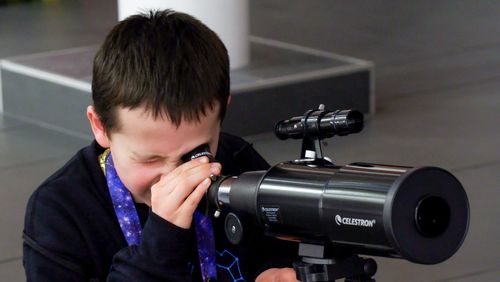
Telescopes out in the world
Swipe for more. Tap a photo to see it big. Photo credits
Taking care of your telescope
- Store it in its case or backpack, somewhere it won't get bumped or dropped. Keep it out of reach of little kids.
- Put the caps back on the lens and eyepieces whenever you finish.
- A little dust on the lens is OK. It takes a lot of dust to change the view.
- Don't wipe the lenses yourself. The glass has thin coatings that scratch easily. Ask an adult who knows telescopes, or a local astronomy club, before you clean anything.
- If you bring your telescope in from the cold and the glass fogs up, take the caps off and let it dry on its own.
Sky challenge
Point to each part of your telescope and name it for someone at home. Then check your case and make sure every part from the list is there.
Check what you learned
Answer all three to finish the lesson and light its star.