A telescope collects light from faraway things and brings it to a focus. That makes them look brighter, bigger, and sharper than they look to your eyes alone.
The opening that collects the light is called the aperture. A wider aperture catches more light, and more light lets you see fainter things. Your eye has an aperture too, the dark pupil in the middle. On a dark night it opens to about 7 millimeters wide.
Drawn to scale. The bigger the opening, the more light it catches.
Both Stellar Dreams telescopes have an aperture of 80 millimeters, a little wider than a baseball. That opening catches about 131 times as much light as your pupil. Stars too faint for your eyes alone appear in the eyepiece.
The first telescopes
1608: the first telescopes
Eyeglass makers in the Netherlands made the first telescopes around 1608. That year, a lens maker named Hans Lipperhey asked the Dutch government for a patent on one.
Photo: Jacob van Meurs
1609: Galileo looks up
The Italian scientist Galileo Galilei heard about the invention and made his own. He pointed it at the sky and saw mountains and craters on the Moon and many more stars than anyone had seen before.
Photo: Justus Sustermans
1610: moons around Jupiter
In January 1610, Galileo found four moons circling Jupiter. His telescope magnified about 20 times, and its lens was much smaller than yours.
Image: Zde, CC BY-SA 4.0
Three main kinds of telescopes
Telescopes collect light in different ways, and most fall into three kinds. Tap each one to watch light travel through it.
A refractor uses a lens. Light passes through the glass at the front, and the glass bends it to a focus at the back, where the eyepiece sits. Galileo's telescope was a refractor.
Refractors
Refractors use lenses. Their tubes are closed, they need little care, and they give sharp views of the Moon and planets. Big lenses get heavy and expensive, so most refractors are small.
Photo: user Kb9vrg
Reflectors
Reflectors use mirrors. A mirror costs less than a lens of the same size, so you get a wider aperture for your money. Almost every big research telescope is a reflector.
Image: The Science Museum UK, CC BY 4.0
Compound telescopes
Compound telescopes use a mirror and a lens. They fit a powerful telescope into a short tube that's easy to carry.
Image: Pelligton, CC BY-SA 4.0
More telescopes
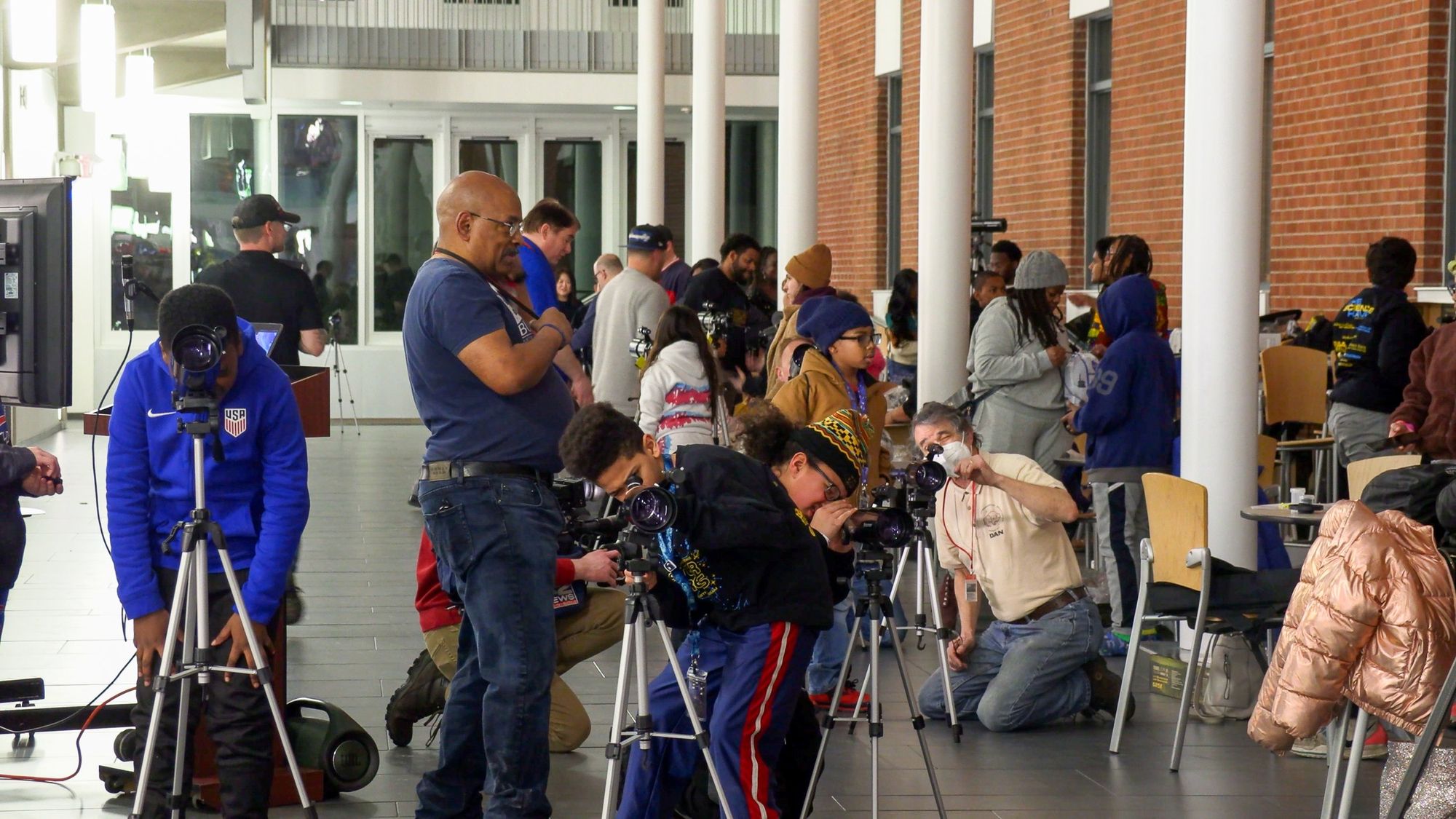
A homemade Dobsonian, a popular kind of reflector.Two telescopes Galileo made, now at the Museo Galileo in Florence, Italy.A student looks at Saturn through a telescope at the University of Wisconsin-Madison.Visitors watch the 2017 solar eclipse at NASA's Goddard Space Flight Center.
Swipe for more. Tap a photo to see it big. Photo credits
Telescope sort
Read each clue. Is it a refractor, a reflector, or a compound telescope?
1 of 8 · Score 0
Galileo's telescope, 1609
Two glass lenses in a tube made of wood and leather.
Giant telescopes on Earth
The biggest telescopes on Earth sit on high mountains in dry places, like Hawaiʻi, the Canary Islands, and the deserts of Chile. Up there the sky is dark, and much of the air that blurs starlight is below them.
Keck Observatory
Two telescopes on Maunakea in Hawaiʻi. Each mirror is 10 meters (33 feet) wide and made of 36 pieces that work together.
Image: International Gemini Observatory/NOIRLab/NSF/AURA/T. Slovinský, CC BY 4.0
Gran Telescopio Canarias
On the island of La Palma, Spain. Its 10.4-meter mirror is the biggest single telescope mirror for visible light.
Image: Michele Albrigo, CC BY-SA 4.0
Very Large Telescope
Four telescopes in Chile's Atacama Desert, each with a mirror 8.2 meters wide. They can work alone or team up.
Image: ESO/G. Hüdepohl (atacamaphoto.com), CC BY 4.0
Vera C. Rubin Observatory
In Chile, with the largest digital camera ever built for astronomy. It shared its first images in 2025 and will photograph the southern sky over and over for 10 years.
Image: NOIRLab/NSF/AURA/C. Corco, CC BY 4.0
Extremely Large Telescope
Being built in Chile. Its mirror will be 39 meters (128 feet) wide. ESO plans its first test observations for 2029.
Image: G. Hüdepohl (atacamaphoto.com)/ESO, CC BY 4.0
FAST radio telescope
A radio dish 500 meters wide, built into a natural bowl in the mountains of Guizhou, China.
Image: SCJiang, CC BY-SA 4.0
ALMA
66 radio antennas high in Chile's Andes mountains that work together as one giant telescope.
Image: ESO/B. Tafreshi (twanight.org), CC BY 4.0
Webb: 6.5 meters (about 21 feet) wide. As tall as a two-story house, made of 18 gold-coated pieces. It's about 81 times wider than your telescope's lens and collects about 860,000 times as much light as your eye.
Telescopes in space
Earth's air blurs starlight and blocks some kinds of light. Telescopes in space sit above the air, so they get a clear, steady view.
Hubble Space Telescope
In orbit since 1990. Astronauts visited it five times to repair and upgrade it.
Photo: NASA
James Webb Space Telescope
Launched in 2021. It sees infrared light from some of the first galaxies in the universe.
Photo: Chris Gunn
Kepler
From 2009 to 2018, it stared at the stars and found thousands of planets around other stars.
Photo: NASA
TESS
Since 2018, it has searched almost the entire sky for planets around nearby, bright stars.
Photo: NASA
Euclid
A European telescope, launched in 2023, mapping billions of galaxies to learn about dark matter and dark energy.
Image: European Space Agency, CC BY-SA 3.0 igo
Nancy Grace Roman Space Telescope
Launched in August 2026. It will take pictures of huge areas of the sky at once, as sharp as Hubble's.
Photo: NASA, NASA-GSFC
Dr. Nancy Grace Roman, NASA's first chief of astronomy. Many people call her the mother of Hubble. Photo: NASA
Telescopes for light you can't see
Visible light is one kind of light. Radio waves, infrared light, and X-rays are light too, and our eyes can't see them. Scientists make telescopes for each kind. Webb, for example, sees infrared light.
Radio telescopes
Radio telescopes look like giant satellite dishes. The Very Large Array in New Mexico links 27 dishes, each 82 feet across, so they work together as one telescope.
Image: CGP Grey, CC BY 2.0
Infrared telescopes
Webb collects infrared light with a gold-coated mirror 21 feet wide, made of 18 pieces. It launched on December 25, 2021, and it can see some of the earliest galaxies in the universe.
Photo: NASA
X-ray telescopes
X-ray telescopes have to work in space, because our air blocks X-rays. NASA's Chandra X-ray Observatory has studied black holes and exploded stars since 1999.
Image: NASA/CXC & J.Vaughan, CC BY 4.0
Webb's First Deep Field. Almost every speck of light in it is a galaxy. Photo: NASA, ESA, CSA, and STScI
Which kind is yours?
Travel Scope 80
Your Travel Scope 80 is a refractor. Light enters the lens at the front of the tube and comes to a focus at the back, where your eyepiece sits.
StarSense Explorer LT 80AZ
Your StarSense Explorer LT 80AZ is a refractor. Light enters the lens at the front of the tube and comes to a focus at the back, where your eyepiece sits.
Another telescope
Look at the front of your telescope's tube.
If the front has a glass lens and the eyepiece sits at the back, it's a refractor.
If the front is open and the eyepiece sticks out the side near the top, it's a reflector.
If a short, wide tube has glass at the front and the eyepiece at the back, it's probably a compound telescope.
Every lesson in this academy works for all three kinds.
Sky challenge
Explain to someone at home what a telescope does and name the three main kinds. Then figure out which kind yours is.
Check what you learned
Answer all three to finish the lesson and light its star.