Lesson 5: Find your way around the night sky
Get your eyes ready for the dark, measure the sky with your hand, and find the North Star.
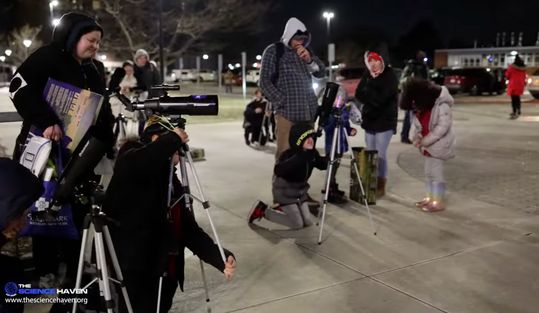
Outside on a clear night.
Get ready
- Check the weather. You need a clear sky.
- Bring an adult.
- Dress warmer than you think you need. Standing still at night gets cold.
- Bring a red light. A red bike light works, or tape red cellophane over a flashlight.
- Bring a star map or an app. Stellarium is free and works on phones and computers. Your telescope's own app works too. That's SkyPortal for the Travel Scope 80 and StarSense Explorer for the StarSense Explorer LT 80AZ.
- Turn on your app's red night mode.
- Set up your telescope before it gets fully dark, and line up the finder.
Give your eyes time
When you step into the dark, your pupils open wide and your eyes slowly get more sensitive. It takes about 20 to 30 minutes for them to adjust. A bright phone screen or a white flashlight undoes it, so stick to red light.
In a city you'll see fewer stars, because the glow from outdoor lights hides the faint ones. The Moon, the planets, and the brightest stars still shine through.
Measure the sky with your hand
Astronomers measure distances across the sky in degrees. From the horizon to straight overhead is 90 degrees. Hold your arm straight out, and your hand becomes a ruler.
- Pinky
- About 1 degree. It covers the full Moon, which is half a degree wide.
- Three middle fingers
- About 5 degrees.
- Fist
- About 10 degrees.
- Spread hand
- About 20 degrees, from thumb to pinky.
This works for kids and grown-ups alike. People with longer arms tend to have bigger hands.
Find the North Star
Polaris, the North Star, sits almost directly above Earth's North Pole. As Earth spins, the other stars seem to circle around it, while Polaris barely moves all night. Find Polaris and you know which way is north.
Polaris isn't the brightest star in the sky. Dozens of stars outshine it. Use the Big Dipper to find it.
- Face north and look for the Big Dipper, seven bright stars in the shape of a big spoon. Depending on the season and the hour, it might be high overhead, low near the horizon, or tipped on its side.
- Find the two stars at the end of the Dipper's bowl, Merak and Dubhe. They're called the pointer stars.
- Draw a line from Merak through Dubhe and keep going, about five times the distance between them.
- The first fairly bright star you reach is Polaris. It sits at the end of the Little Dipper's handle.
Cassiopeia, a W of five stars, sits on the other side of Polaris from the Big Dipper. When the Dipper is low, Cassiopeia is high, so one of them is usually easy to spot.
Polaris tells you your latitude
Measure how high Polaris sits above your horizon. That angle almost matches your latitude, which tells how far north of the equator you live. Sailors used this trick to find their way across the ocean.
StarSense Explorer LT 80AZ
Let your StarSense app guide you
Once you've set up the app in Lesson 3, put your phone in the dock and open it. Pick a target from its list of things up tonight. Move the telescope the way the arrows point until the bullseye turns green, then look in the eyepiece.
Sky challenge
Find the Big Dipper, then follow the pointer stars to Polaris. Measure how many fists Polaris sits above your horizon, and compare it to your city's latitude.
Check what you learned
Answer all three to finish the lesson and light its star.