Lesson 6: Explore the Moon
Learn why the Moon changes shape, then find craters, mountains, and plains of old lava.
Outside, any time the Moon is up.
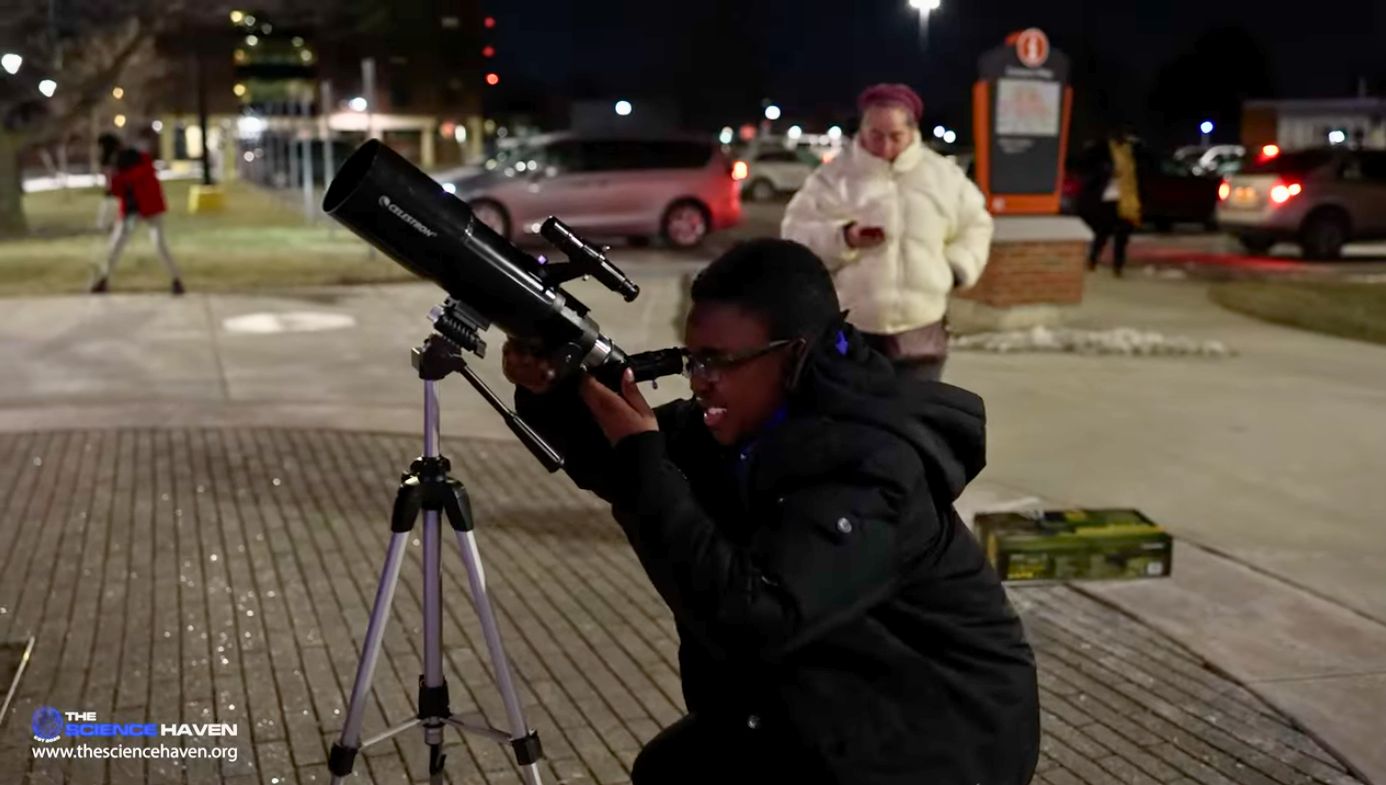
The Moon is the best first target for any telescope. It's bright, big, and easy to find, and it looks amazing at every power.
Why the Moon changes shape
The Moon makes no light of its own. Sunlight always lights up half of it, the half facing the Sun. As the Moon travels around Earth, we see different amounts of that lit half. One full trip through the phases takes about 29 and a half days.
In your sky
From above Earth
Waxing means the lit part is growing. Waning means it's shrinking. A gibbous Moon is more than half lit.
Look along the shadow line
The line between the Moon's day side and night side is called the terminator. Near it, the Sun sits low in the Moon's sky, so mountains and crater walls cast long shadows. The Moon looks the most 3D there, and it's the best place to point your telescope.
At full Moon, sunlight hits the side facing us straight on. The shadows disappear, so the Moon looks flat and very bright. Full Moon is the best time to see the bright streaks, called rays, that spread out from the crater Tycho.
What you're looking at
Craters
Round pits made when space rocks crashed into the Moon. Some are more than 100 miles wide.
Maria
The dark gray patches. They're plains of hardened lava from volcanic eruptions billions of years ago. Early astronomers thought they were seas and named them maria, the Latin word for seas. Apollo 11 landed in one, the Sea of Tranquility, in 1969.
Mountains
Look for bright peaks poking out of the dark side, just past the terminator. Sunlight reaches their tops first.
Apollo 11 in the Sea of Tranquility
Swipe for more. Tap a photo to see it big. Photo credits
The Moon always keeps the same side facing Earth. Learn its features once, and they'll be in the same spots every time you look.
Take a picture
Travel Scope 80
Your Travel Scope 80 came with a smartphone adapter. Clamp it onto the eyepiece, set your phone in it, and line the phone's camera up with the eyepiece. Tighten the knobs, then tap the Moon on your screen to focus. If the Moon looks too bright, lower your camera's exposure.
StarSense Explorer LT 80AZ
Hold your phone's camera right up to the eyepiece and move it slowly until the Moon fills your screen. It takes practice, so take lots of shots. Tap the Moon to focus, and lower the exposure if it looks too bright.
Another telescope
Hold your phone's camera right up to the eyepiece and move it slowly until the Moon fills your screen. A phone adapter for telescopes makes it easier. Tap the Moon to focus, and lower the exposure if it looks too bright.
The Moon is often up during the day too, especially in the afternoon around first quarter. You can look at it in daylight, but only with an adult, and only when the Moon is far from the Sun.
Draw it like Galileo
Galileo didn't have a camera. He drew what he saw, and his drawings changed how people thought about the Moon. Try drawing the shadow line when you log your sky challenge below.
Every year, NASA hosts International Observe the Moon Night, when people around the world look at the Moon together.
Sky challenge
Look at the Moon on three different nights. Each time, draw what you see along the shadow line or take a photo, and write down the date and the phase.
Check what you learned
Answer all three to finish the lesson and light its star.